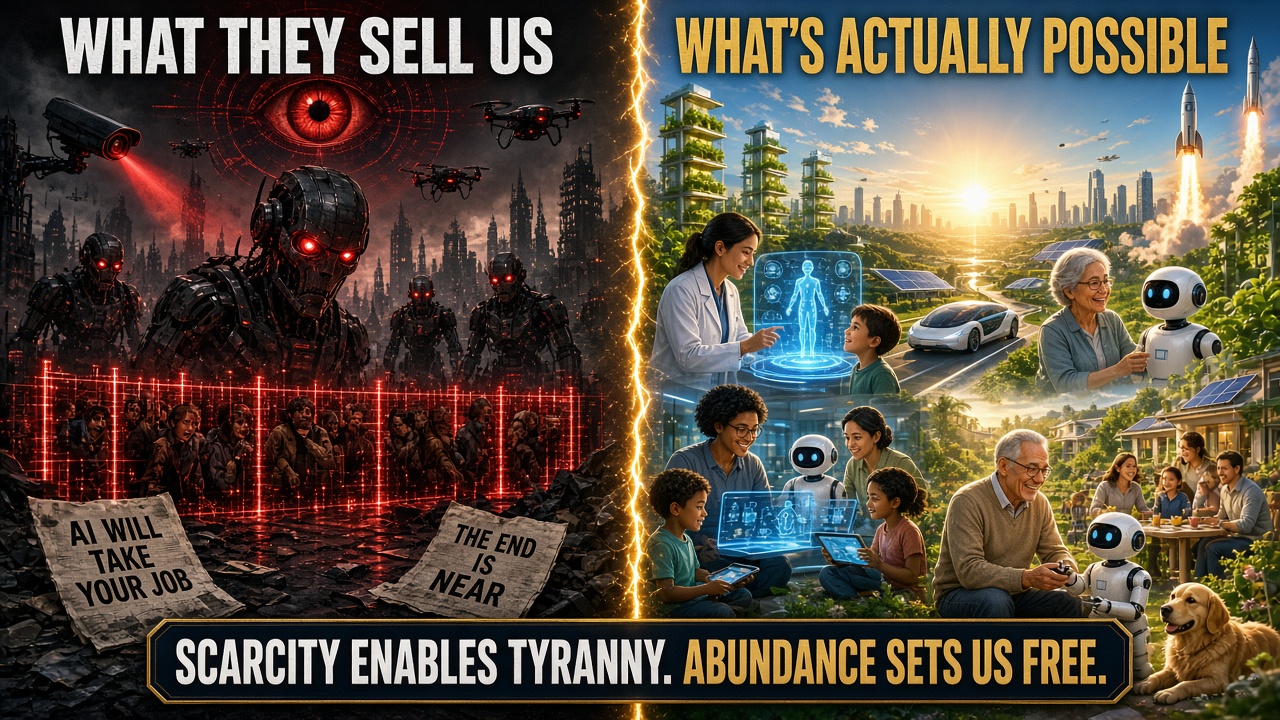
I’ve been running my own business most of my life, and I’ve heard plenty of end-of-the-world predictions. Back in 1964, a group of scientists and activists sent President Johnson a memo called “The Triple Revolution,” warning that computers and automation would soon wipe out work as we knew it. One of the podcasters said it was the oldest warning of its kind he could find. Sixty years later, people are still working, and the same fear is being sold again with a fresh coat of paint.
So I want to point you toward some people who are doing something more useful than selling fear.
Two podcasts, Moonshots and All-In, plus one independent voice, bring together some of the most hopeful builders I know of. Every week, Peter Diamandis hosts Moonshots. Peter was born in the Bronx to Greek immigrant parents. He started XPRIZE and co-founded Singularity University. His regular co-hosts are Salim Ismail, born in Hyderabad, India, and raised in India and Canada; Dave Blundin, an American venture investor and MIT-trained AI veteran; and Dr. Alexander Wissner-Gross, an American physicist and computer scientist. A frequent guest is Emad Mostaque, a British-Bangladeshi mathematician born in Jordan, who founded Stability AI. On the All-In podcast you’ll find David Sacks, born in Cape Town, South Africa; Chamath Palihapitiya, born in Sri Lanka and raised in Canada; David Friedberg, also born in South Africa; and Jason Calacanis, from Brooklyn.
And there’s a third voice. Farzad Mesbahi, an Iranian-American former Tesla engineer, wrote the book Abundance or Collapse and has been making the same case on his own show: we can build our way out of scarcity if we choose to.
That is a table with roots on four continents. These folks are working hard to make life better for regular people, and they get nowhere near the attention the doom merchants get.
Think about that. Many of these men came to America from somewhere else, and they came because of what the Founding Fathers built: a land where all might be free, a promise not yet kept for everyone in 1776, but one they wrote down so it could be. Frederick Douglass, who escaped slavery himself, came to call the Constitution “a glorious liberty document” for exactly that reason. It was also built as a land where the abundance we create is kept by the people who create it. And Americans have always done something remarkable with that abundance. They give it away. Private Americans give more to charity than the people of any other nation, more than half a trillion dollars a year, and successful people here have a long history of lifting up their less well-off neighbors. In my experience, when that job gets handed to the government, it gets done less efficiently, and something quieter is lost too. When government is seen as the one responsible for taking care of people, many of us feel less personal need to step in. It becomes easier to assume someone else has it covered. That tradition of neighbor helping neighbor, rather than waiting on an agency, is part of what has made America different, and it’s worth protecting. Now they’re reminding us of what we gained and have forgotten. In December 1776, in The American Crisis, Thomas Paine warned us: “What we obtain too cheap, we esteem too lightly: it is dearness only that gives every thing its value.” We are about to hand this opportunity to the people who manufacture scarcity and crisis, and then, in the name of the good of the people, march us back onto the plantation. A group of immigrants is working to keep that from happening. The least we can do is listen.
Here’s what they understand that the doomers skip over. Scarcity is how tyrants have always controlled people. If there isn’t enough food, energy, medicine, or opportunity to go around, whoever controls the supply controls you. Abundance is the way out of that trap.
But let’s be honest about where we are right now. The scarcity is real. People are struggling to pay rent, buy groceries, and keep their jobs, and that pain isn’t imaginary. What I respect about these men is that they don’t pretend otherwise. They spend a lot of their time on the hard question of the transition: how do we help people who are hurting today see a path to the abundance that’s within reach? The answer isn’t to stay fixed on the pain, and it isn’t to hand our lives to the people who profit from keeping things scarce. It’s to support the ones who are trying to lead us to the off-ramp, and to take the first steps ourselves.
The real danger isn’t a movie robot. It’s AI in the hands of tyranny. Look at China, where the Communist Party runs the Great Firewall and watches what its people read and say. Pair that kind of power with AI and you get a cage nobody can see the bars of.
Most of what AI will actually do isn’t glamorous. Edison said genius is one percent inspiration and ninety-nine percent perspiration. AI is the same way. About ninety-nine percent of it is plain execution work, and that work should reach ninety-nine percent of people. Think of utility AI the way we think of the power grid: courts that clear their backlog, doctors with a second set of eyes, roads that get fixed before they fail, schools that meet every kid where they are, and a DMV visit that takes minutes instead of a morning.
How do we keep it honest? The founders already answered that. In Federalist No. 51, James Madison wrote that “ambition must be made to counteract ambition.” Nobody gets unchecked power. I’d apply the same rule here: many independent AIs, built by different people, checking each other’s work. They don’t all have to agree. They need to be aligned toward the good of people, not the good of a small number of rulers, each in charge of their own corner of the world.
Farzad Mesbahi describes this moment as a fork in the road. He’s right that there’s a fork. One side leads to abundance. The other is the normal path of history, the one humanity has always traveled, where power ends up concentrated in the hands of a few who manage the masses. But calling it a fork plays down what’s really in front of us. This is an off-ramp from the road we’ve been on for all of recorded history. For the first time, ordinary people can gain the power to know the truth and to multiply their own creativity and work, for their own benefit, with less effort. Think of a man plowing a field by hand, and then think of that same man on a tractor, suddenly producing more than a whole village used to. AI can do that for the mind. I challenge anyone to show me another time in history when there was such a clear and obvious chance to leave that old road for one that could lead permanently to abundance for people at large. Off-ramps don’t stay open forever. If we miss this one, it is highly unlikely we will ever get another. We already have an example of the other road. Behind China’s Great Firewall, people are kept from knowing anything Big Brother doesn’t want them to know, and they’re fed the “truth” that Big Brother’s truth commission promotes. (I wrote more about that in The Off-Ramp Isn’t Getting the Publicity.)
Peter is even putting money behind a better story. His Future Vision XPRIZE rewards filmmakers for showing a hopeful future instead of another apocalypse. People build toward what they can picture.
So here’s my ask. Spend an hour with these folks. Start with Moonshots #294, “Why Jensen and Zuck think the doomers are wrong (plus AI gets a rebrand),” where the crew sits down with Emad Mostaque to talk about Nvidia’s Jensen Huang pushing back on the doomers. Then give All-In a listen.
Moonshots: https://www.diamandis.com/podcast
All-In: https://allin.com
Then decide for yourself which picture you want to help build.
Ego = 0, Truth = 1, Mission accomplished = 1.
Ross Howell